AI-Powered Admissions: How Universities Turn Bulk Data into High-Intent Leads | AInfoSci Blogs
Learn how AI-powered admission intelligence transforms bulk student data into high-intent leads, lowering acquisition costs and boosting university conversions. Discover how AInfoSci empowers admissions teams with automated lead scoring, personalized engagement, and smart workflows.
Article
- AI in Higher Education
- University Admissions
- Lead Qualification
- AI Lead Scoring
- Higher Ed Marketing
Every admission season, universities and colleges face a familiar situation. There is no shortage of student data. In fact, there may be too much of it.
Yet, despite having access to such large quality databases, many institutions continue to struggle with one fundamental question:
Which students are actually worth pursuing?
This is where the real challenge of modern university admissions begins.
The problem is no longer simply about generating more leads. It is about converting a large volume of raw data into meaningful, high-intent admission opportunities.
For university founders, directors, and admission heads, this has become a business problem as much as a marketing problem. Every unproductive call consumes manpower. Every irrelevant lead increases acquisition costs. Every missed high-intent student represents a lost admission opportunity.
The question, therefore, is not whether an institution has enough data.
The question is whether the institution is intelligent enough to use that data.
The Admission Problem: Lakhs of Records, But How Many Real Prospects?
Consider a university with access to 100,000 student records. On paper, this looks like an enormous opportunity.
But imagine distributing these records among a large team of telecallers and asking them to start calling.
The first challenge appears immediately:
-
Some students may not be interested in the program.
-
Some may have a budget that does not match the institution’s fee structure.
-
Some may prefer another city.
-
Some may have already shortlisted another university.
-
Some may be exploring completely different programs.
-
Some may have taken the examination simply as an option and have no immediate intention of taking admission.
Meanwhile, the telecaller continues calling because the database says that the student is a potential lead.
This creates a costly mismatch between data availability and actual student intent. A university may have 100,000 records, but perhaps only a much smaller proportion of those students should receive immediate human attention.
This is where Artificial Intelligence can create a fundamental change. Instead of asking the admission team to call more people, AI can help the institution understand the data first.
The objective is to move from bulk lead generation to intelligent lead qualification.
Students Today Have More Choices—and Less Patience for Generic Communication
The higher-education decision-making environment has changed. An aspirant may simultaneously explore several universities, compare programs, check placement information, look at fees, search for reviews, watch campus videos, speak to friends and parents, and evaluate alternative institutions.
The difficulty for universities is that almost every institution communicates similar messages:
-
Experienced faculty
-
Excellent infrastructure
-
Industry exposure
-
Strong placements
-
International opportunities
-
Holistic development
-
Modern campus
These may all be important, but when every institution says almost the same thing, the real question becomes:
Why should this particular student choose your institution?
The answer cannot always come from another generic advertisement. It has to come from understanding the student’s priorities.
One student may be primarily interested in placements. Another may be concerned about affordability. Another may want a particular specialization. Another may prefer a particular location. Someone else may be interested in international exposure or entrepreneurship.
This is where AI-supported personalization becomes valuable. Instead of treating every student as the same lead, an institution can begin to understand prospects according to their relevant characteristics, preferences, and engagement signals.
The communication can then become more meaningful. Rather than repeatedly saying, "Admissions Open—Apply Now," the institution can communicate the specific value proposition that is most relevant to the prospect.
From Raw Admission Data to Admission Intelligence
Traditional databases are very good at storing information. AI can help institutions derive intelligence from that information.
Imagine an admission database containing academic information, entrance examination scores, geography, program preferences, enquiry history, and permitted engagement information. An AI-powered system can analyze these signals and help create meaningful prospect segments according to the institution’s own admission criteria.
The objective is not simply to create more categories. The objective is to answer a much more valuable question:
Who should our admission team focus on first?
The institution could identify:
-
Prospects who appear to have stronger program fit.
-
Prospects who need additional nurturing.
-
Prospects who may be suitable for a campus visit.
-
Prospects who are not currently ready for human intervention.
This changes the role of the admission team. Instead of starting the morning with a spreadsheet containing hundreds of names, a counsellor can start with a prioritized list of prospects and the reason each prospect has been prioritized.
That is the difference between a database and an intelligence system.
How Do We Persuade the Right Student to Visit Our Campus?
Getting a student’s contact information is not the same as getting their attention. And getting their attention is not the same as getting them to visit the campus.
The campus visit is often a critical stage in the admission journey because it allows the student and family to experience the institution beyond advertising. However, a campus-visit invitation sent to every student may not produce meaningful results.
AI can help institutions identify which prospects are more appropriate for a personalized campus-visit invitation based on their program interest, location, engagement, and other institution-defined criteria.
The message can then be far more relevant:
-
Placements-focused: A student interested in placements can be shown placement-related information and invited to interact with the placement team.
-
Specialization-focused: A student interested in marketing can receive information about the marketing specialization, relevant faculty, projects, and industry exposure.
-
Location-based: A student from the same city can receive a local campus-visit invitation.
-
Relocation-focused: A student considering relocation may need information about hostel facilities, campus life, and student support.
The objective is not to send more messages—it is to make each meaningful interaction more relevant.
This Is Where an AI Admission Agent Can Change the Process
Now imagine the university has a customized AI Admission Intelligence Agent built around its admission objectives.
Instead of immediately sending every raw record to a telecaller, the institution can allow the AI layer to analyze and qualify the available data according to predefined business rules and permitted data sources.
The university could ask the system questions such as:
-
"Identify prospects interested in our MBA program who meet our eligibility criteria."
-
"Show prospects from our priority geographic markets."
-
"Identify high-engagement prospects who have not yet applied."
-
"Which prospects may be suitable for our upcoming campus visit?"
-
"Which prospects require human counselling?"
-
"Which prospects should enter a nurturing communication journey?"
This is where AI moves beyond being a chatbot—it becomes an admission intelligence layer between the university’s data and its human admission team.
The Structured AI Admission Journey
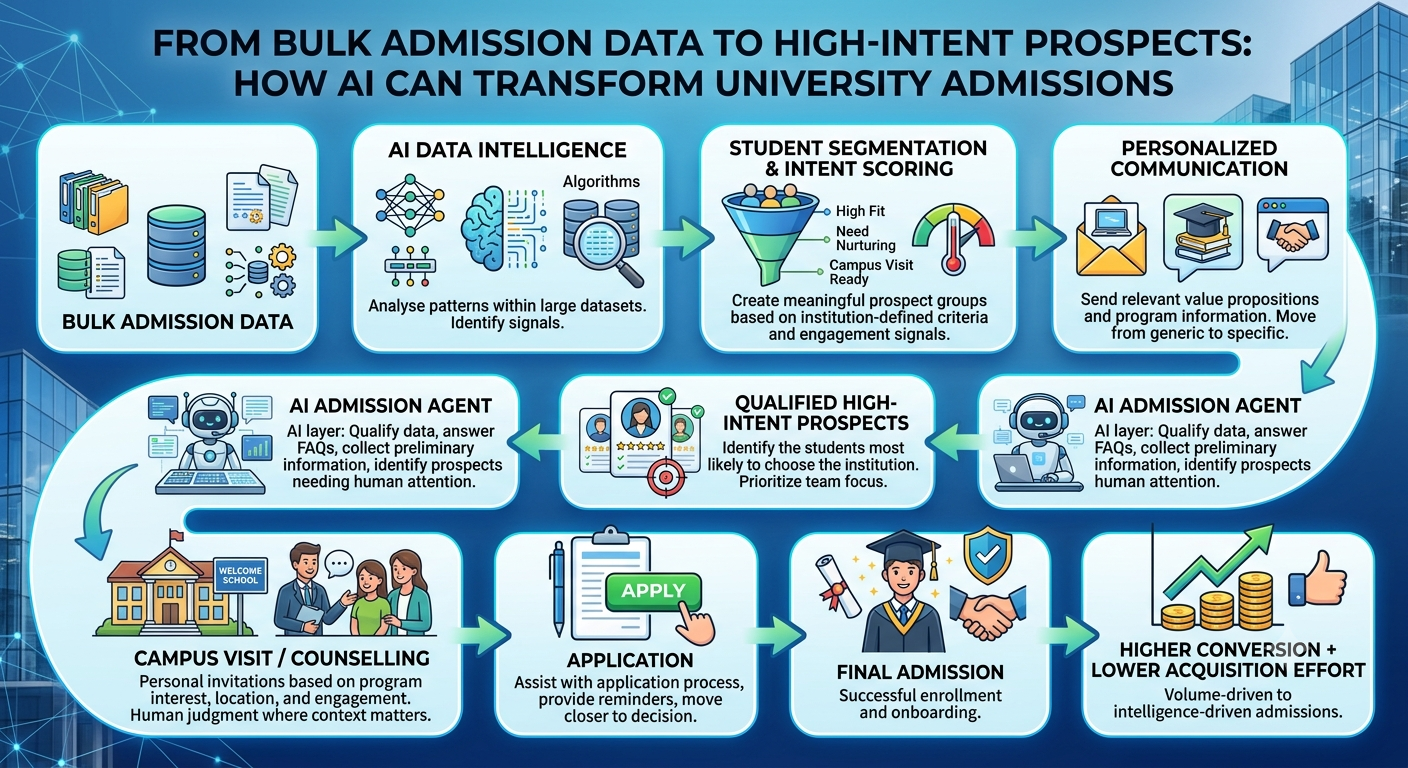
Raw Data → AI Analysis → Prospect Segmentation → Lead Qualification → Personalized Engagement → Campus Visit → Counselling → Application → Admission
What Happens to the Telecalling Team?
This is one of the most important business questions.
AI should not necessarily be positioned as a replacement for admission counsellors; it should be positioned as a way to make their time more valuable.
A telecaller should not have to spend the majority of the day asking basic questions to students who have little interest or poor program fit. AI can assist with repetitive and structured interactions, answer frequently asked questions, collect preliminary information, qualify prospects, and maintain appropriate follow-up workflows.
Human counsellors can then concentrate on the conversations where human judgement matters most. When a student has serious questions about program selection, career outcomes, fees, family concerns, or final decision-making, the counsellor can step in with full context already available.
The Human + AI Admission Model
|
| AI Handles | Humans Handle |
| Scale | Trust |
| Pattern Processing | Persuasion & Complex Objections |
| Automated Follow-ups | Relationship Building |
The objective is therefore not to remove the human element from admissions. It is to remove unnecessary human effort from low-value activities.
The Real Conversion Strategy: Move the Student Forward
Many admission teams measure success through the number of calls made. But the number of calls does not necessarily represent business performance.
A better admission funnel asks:
-
How many students became aware of the institution?
-
How many showed interest?
-
How many became qualified prospects?
-
How many interacted with the institution?
-
How many visited the campus?
-
How many submitted applications?
-
How many attended counselling?
-
How many finally enrolled?
AI can help institutions monitor this movement. Instead of simply recording that "a student was contacted," the institution can start understanding the student’s stage in the admission journey:
-
Awareness Stage: The student needs to understand what makes the institution different.
-
Consideration Stage: They need program, placement, fee, or ROI information.
-
Campus-Visit Stage: They need a personalized invitation.
-
Application Stage: They need assistance and reminders.
-
Final Decision Stage: They need human counselling.
The core principle is simple: Every interaction should have a purpose in moving the student closer to a decision.
The AInfoSci AI-Powered Admission Intelligence Framework
The AInfoSci approach consists of five connected stages:
-
Data: Brings together relevant and permitted information from the institution’s existing admission ecosystem (entrance exams, enquiries, campaign responses, program preferences, geographic info).
-
AI Intelligence: Uses AI and machine-learning techniques to identify patterns, program fit, engagement, and admission potential within large datasets.
-
Segmentation & Personalization: Creates meaningful prospect groups that receive tailored communication journeys based on their needs and journey stage.
-
AI Admission Agent: Supports routine conversations, answers FAQs, collects qualifying info, and flags prospects that require human intervention.
-
Counsellor & Conversion Support: Transfers high-priority, high-intent prospects to counsellors with full background context, enabling higher conversion rates.
The Framework in One View
BULK DATA
   ↓
AI DATA INTELLIGENCE
   ↓
STUDENT SEGMENTATION & INTENT SCORING
   ↓
PERSONALIZED COMMUNICATION
   ↓
AI ADMISSION AGENT
   ↓
QUALIFIED HIGH-INTENT PROSPECTS
   ↓
CAMPUS VISIT / COUNSELLING
   ↓
APPLICATION
   ↓
FINAL ADMISSION
   ↓
HIGHER CONVERSION + LOWER ACQUISITION EFFORT
What Can AInfoSci Build for Universities and Colleges?
At AInfoSci, the opportunity is not simply to provide another software dashboard. The larger opportunity is to build an AI-enabled admission ecosystem around the institution’s actual business problem.
AInfoSci works with institutions to understand their admission processes, available data, target programs, geographical priorities, student profiles, and conversion challenges—designing an appropriate AI and analytics architecture customized to their needs.
This architecture can include:
-
AI-powered student segmentation systems
-
Lead-scoring models
-
Real-time admission dashboards
-
Personalized communication workflows
-
Conversational AI agents
-
Automated lead qualification
-
Counsellor prioritization rules
-
Admission-funnel analytics
This customization is crucial because an MBA-focused private university, an engineering college, a management institute, and a multidisciplinary university all have completely different student decision journeys. The technology should adapt to the institution’s strategy—not the other way around.
Imagine the Difference in the Daily Life of an Admission Team
Traditional Model
-
Morning starts with a large spreadsheet (hundreds of numbers and names).
-
Telecallers make hundreds of cold calls.
-
Uncertainty remains around who is actually serious.
AI-Assisted Model
-
Management sees prioritized prospects based on intent.
-
Counsellors jump straight into qualified, context-rich conversations.
-
The team clearly understands campaign engagement and drop-off points.
-
High-intent prospects get tailored invitations to visit campus.
-
Leadership gets full visibility into admission revenue sources and acquisition efficiency.
The Future of University Admissions Is Not More Data. It Is Better Intelligence.
Universities will continue to collect enormous amounts of student data. However, the competitive advantage will not belong to the institution with the largest database; it will belong to the institution that makes the best use of its data while respecting student privacy, consent, and responsible data practices.
The Shift in Admission Strategy
| From (Traditional) | To (Future-Ready) |
| More Leads | Better Intelligence |
| More Calls | Better Prospects |
| More Follow-ups | Better Engagement |
| Generic Messaging | Better Campus Visits |
| Volume Metrics | Better Conversion |
For university founders, directors, and admission leaders, this represents a crucial shift:
-
Stop wasting human counselling capacity on prospects who were never likely to convert.
-
Extract actionable intelligence from legitimately available data instead of buying more cold leads.
-
Build a predictable journey from raw prospect to final enrolled student.
Take the Next Step with AInfoSci
By combining Artificial Intelligence, Machine Learning, Data Analytics, Automation, GenAI, and customized AI agents, institutions can transform admission operations from a volume-driven struggle into an intelligent, personalized, and measurable growth engine.
Ask yourself:
"How intelligently are we using our records to identify the students who are most likely to choose us?"
If your institution is sitting on thousands or lakhs of student records while your admission team spends hours on manual cold calls, it is time to rethink your process.
AInfoSci can help you transition:
Because the future of university admissions is not about calling more students—it is about understanding the right students better and empowering your team to convert them.
AInfoSci — AI, Data & Intelligent Business Transformation for Higher Education.
Contact
Apply these ideas to your business
Interested in implementing what you read? Book a free consultation or tell us about your project. We typically respond within 1–2 business days.
Prefer to talk first? Reach us directly.
Rajasthan- 302020, India