

Beyond Text Dumps: Why Structure-Aware OCR is the Missing Engine for EdTech AI | AInfoSci
Unstructured academic paperwork locks away institutional memory and slows enrollment. Here is how structure-aware document parsing turns complex transcripts, assessment forms, and research archives into RAG-ready knowledge
Article
- EdTech Document AI
- Structure-Aware OCR
- Higher Ed RAG Pipelines
- Academic Data Unification
- FERPA Compliant AI
Most educational institutions do not suffer from a lack of data. They suffer from a lack of usable structure.
Scanned transcripts, handwritten assessment sheets, multi-column research papers, accreditation binders, and legacy financial receipts sit trapped in static PDFs and local network drives. While readable to human eyes, this material remains remarkably brittle when fed into modern software. Traditional Optical Character Recognition (OCR) engines simply extract raw characters into unstructured text dumps. When downstream Retrieval-Augmented Generation (RAG) models or autonomous AI agents consume this unformatted text, critical context collapses: transcript grade tables lose their alignment, application form fields drop their labels, and complex academic layouts scramble into unsearchable noise.
To unlock true institutional intelligence and build high-performing AI tools, EdTech platforms and higher education leaders must shift from simple character recognition to structure-aware document intelligence.
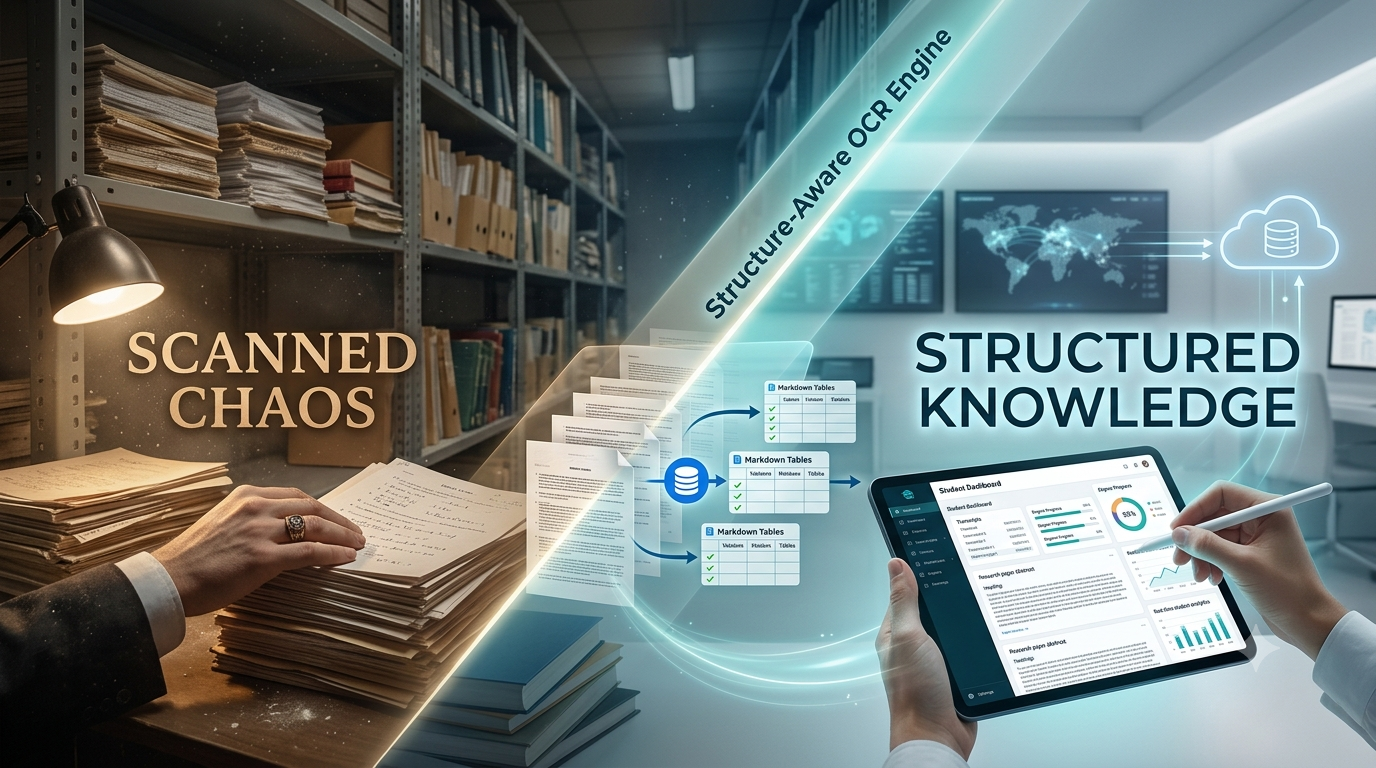
The Core Technical Shift: Restructuring the Pipeline
Traditional document workflows follow a linear, highly fragile path:
Structure-aware OCR (such as Mistral OCR 3) flips this middle layer. Rather than outputting arbitrary bounding boxes or flat text strings, it converts incoming documents directly into semantic Markdown and HTML table structures. It preserves merged cells, section hierarchies, and multi-column forms as native units that downstream AI models can accurately process.
Strategic Architectural Advantages
-
Tables as First-Class Entities: Academic transcripts, course schedules, and financial ledgers retain their explicit row and column relationships, enabling RAG systems to cite specific cells rather than guessing from adjacent prose.
-
Handwriting & Archival Usability: Handwritten instructor notes, blue-book exams, and legacy student records move from permanent administrative blind spots to accessible digital assets.
-
Batch Economics for Backlog Digitization: Commodity API and batch processing rates (2 per 1,000 pages) make digitizing 20 years of paper records financially viable, moving institutions beyond "born-digital only" limitations.
-
Granular Citation & Grounding: Parsed documents retain structural provenance (Page Section Table Cell), offering verifiable citation trails essential for academic rigor and audit compliance.
Solving the Unstructured Friction in Academic Operations
When institutional documents remain unformatted, manual data entry becomes a silent tax on university growth and operational agility. Structure-aware document processing directly addresses four primary higher ed bottlenecks:
1. Admissions and Credit Transfer Processing
Evaluating transfer applicants requires manual review of non-standard transcripts across hundreds of domestic and international institutions. By deploying structure-aware OCR, admissions teams can automatically extract course codes, descriptions, credits, and letter grades into structured tables, reducing transfer evaluation cycles from 14 days to under 2 hours while maintaining full auditability back to the original scan.
2. Assessment and Learning Analytics
A substantial portion of authentic student evaluation—especially in STEM, humanities, and early childhood education—remains handwritten. Structuring handwritten assessment sheets into normalized text allows faculty to run cohort-level learning analytics, identify common conceptual errors, and provide targeted feedback without spending dozens of hours manually keying in scores.
3. Accreditation Binders and Policy Governance
Preparing for regional accreditation reviews (such as SACSCOC, WSCUC, or HLC) often forces administrative teams into weeks of "folder archaeology." A private RAG index built on structured course syllabi, faculty CVs, governance notes, and historical policy PDFs allows compliance officers to query institutional memory instantly with natural language.
4. Administrative Operations and Financial Processing
From vendor invoices and research grant receipts to financial aid documentation, clerical teams spend thousands of hours re-keying data into enterprise systems. Automated ingestion pipelines reduce processing overhead by up to 70%, redirecting staff capacity toward high-value student engagement.
Enterprise Governance, Security, and Compliance
Deploying document AI in higher education demands strict alignment with regulatory requirements and existing core platforms:
Here is the converted Markdown table:
| Enterprise Concern | Implementation Strategy |
|---|---|
| System Integration | Direct connectors push verified data to SIS (Ellucian, Workday) & LMS (Canvas). |
| FERPA & Privacy | Redact PII prior to vector indexing; restrict tenant indexes by program. |
| Verification (HITL) | Enforce Human-in-the-Loop review thresholds for financial amounts, IDs, and marks. |
| Cost Optimization | Route clean, native PDFs to light text parsers; save OCR 3 for scans & tables. |
-
FERPA & GDPR Compliance: Student records contain non-public personal information. Processing layers must enforce strict tenant isolation, ensuring student data processed for one department or campus is never exposed across global retrieval indexes.
-
LMS and SIS Interoperability: Extracted fields (such as course equivalencies or grade updates) should flow directly into core systems like Canvas, Blackboard, Ellucian Banner, or Workday Student via automated webhooks, keeping the underlying raw Markdown as an audit trail.
-
Human-in-the-Loop (HITL) Guardrails: AI models should treat extractions as candidate data. For high-stakes decisions—such as final grade posting, degree audit approvals, or tuition adjustments—a human administrator must remain in the loop via automated review queues.
The Strategic Path Forward
Transitioning from traditional OCR to structure-aware document intelligence converts historical document debt into a proprietary competitive asset. Institutions that modernize their document ingestion pipelines unlock three key advantages:
-
Faster Enrollment Timelines: Rapid transcript evaluation prevents prospective transfer students from dropping out of the admissions funnel.
-
Grounded Institutional Memory: Staff and faculty gain immediate, verifiable answers from decades of policy, curriculum, and administrative archives.
-
Hyper-Personalized AI Tutoring: Student-facing AI study assistants can draw directly from structured syllabi, course packets, and textbook charts with precise citation grounding.
While OCR models will continue to advance, production success depends on system design: intelligent preprocessing, strict tenant routing, transparent citations, and governed human verification.
Request an Institutional Document AI Audit
Is your institution ready to turn cabinets of unsearchable PDFs into actionable RAG intelligence? AInfoSci helps higher education leaders and EdTech platforms architect governed, structure-aware document pipelines aligned with SIS/LMS ecosystems and FERPA compliance.
[Schedule a 30-Minute Architecture Review with Our EdTech Practice]

Contact
Apply these ideas to your business
Interested in implementing what you read? Book a free consultation or tell us about your project. We typically respond within 1–2 business days.
Prefer to talk first? Reach us directly.
Rajasthan- 302020, India